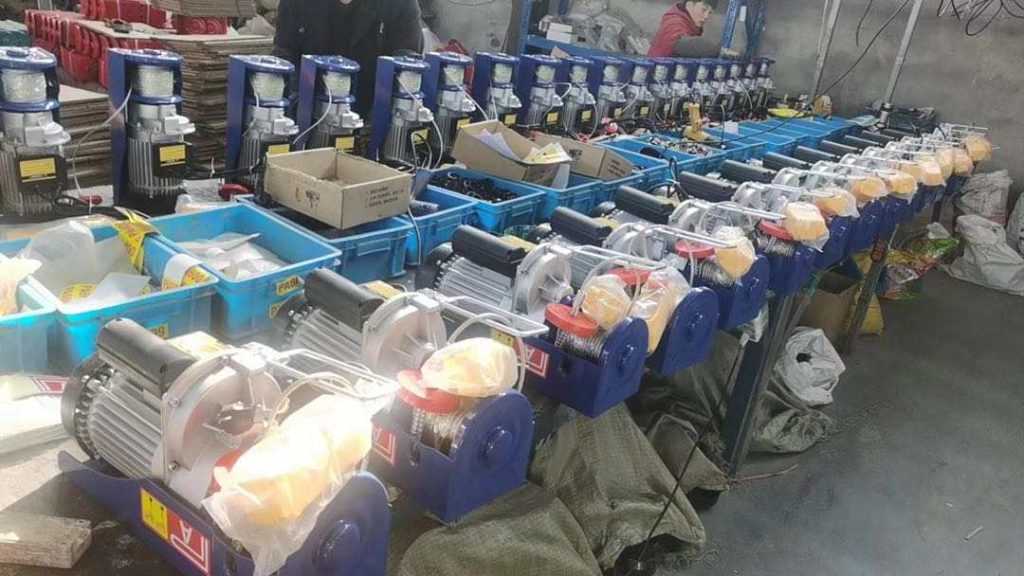
mini electric hoist
What is the reason for the abnormal noise of a small electric hoist crane?
Small electric hoist cranes are generally used at home, on relatively small cranes, and then operated remotely. Long term use has been reported to cause loud noise problems, so it needs to be repaired in a timely manner. Below, we will explain where the problem lies.
In general, we can take the following measures to repair this situation.
Abnormal noise occurs in the control circuit, and the noise that is pronounced as “hum” is usually caused by a malfunction of the miniature electric hoist contactor (such as poor contact of the AC contactor contacts, voltage level mismatch, magnetic core jamming, etc.). The faulty contactor should be repaired, and if it cannot be repaired, it is necessary to replace it. After treatment, the noise will be eliminated on its own.
If the motor announces abnormal noise, it should be stopped immediately to check whether the motor is running single-phase, or if the bearings are damaged, the shaft axis of the coupling is not correct, or if there are problems such as “sweeping the chamber”. These can cause abnormal noise in the motor, and the sound direction, height, and frequency of different problems are different. When the motor is running single-phase, it will announce a regular “buzzing” sound that varies in strength and weakness; when the bearings are damaged, it will announce a “buzzing” sound accompanied by a “clunking” sound near the bearings; When the axis of the coupling is not aligned, or when the motor is slightly sweeping the bore, the entire motor emits a very high “buzzing” sound, accompanied by sharp and sharp sounds from time to time.
Abnormal noise is announced from the reducer, indicating that there is a problem with the reducer (such as lack of lubricating oil in the gearbox or bearings, gear wear or damage, bearing damage, etc.), and the machine should be stopped for inspection.
However, it is also necessary to confirm whether the gearbox or bearings of the reducer have been lubricated before use, and whether the lubricating oil is replaced regularly during use. If not lubricated as required, the reducer will not only produce excessive “buzzing” sound, but also wear or damage the gears and bearings excessively.