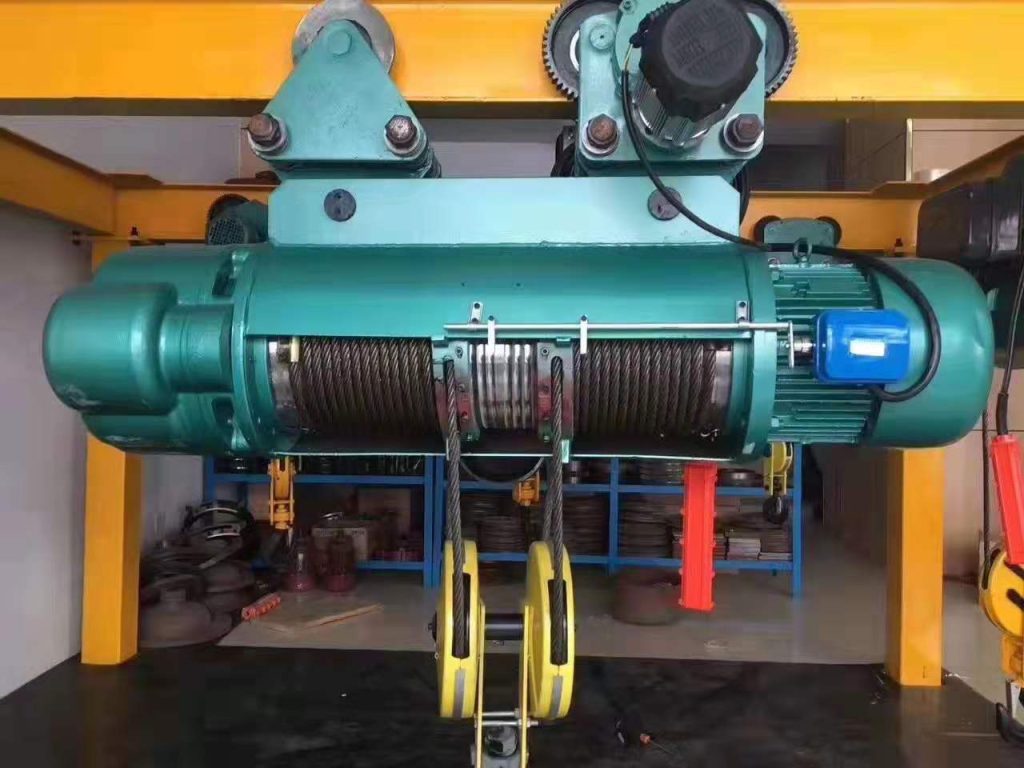
electric wire rope hoist
Analysis of the Reasons for the Air Stop of 5-ton Relectric wire rope Electric Hoist
During the lifting process, it is inevitable that there will be lifting failures. Next, we will analyze the reasons for the 5-ton wire rope electric hoist.
The primary consideration is poor contact of the sliding contact wire. When the electric hoist passes through the sliding contact line interface, it is common for the electric hoist to suddenly stop, and in severe cases, it may be burned due to phase loss.
Some electric hoist contact wire models are DHG-4-16/DHG-4-15, which are sliding contact wires embedded in specially manufactured semi closed engineering plastic conduits with multi pole copper guide rails with insulated slot plates as transmission busbars. Due to factors such as the quality of the sliding wire and the on-site environment, the plastic casing of the sliding contact wire is fragile and severely deformed during transportation and installation,
Increased difficulty in installing sliding contact wires. There is a simple misalignment phenomenon at the interface between the sliding wires, which often leads to poor contact and phase loss or power outage when the current collector passes through the interface, causing the electric hoist to suddenly stop.
Next, consider the collector, model JD-4-40S/JD-4-60, which is equipped with a built-in tension spring to support the sliding carbon brush and make contact with the sliding wire. Coastal areas have abundant rainfall and high air humidity, among other environmental factors,
The tension spring simply corroded and failed, resulting in poor contact between the carbon brush and the sliding wire. However, there is a chamfer in the orientation of the carbon brush contacts. When the carbon brush passes through an uneven sliding line interface, the electric hoist has low inertia and the carbon brush contacts cannot successfully pass through the interface, resulting in poor contact of one phase of the collector.